Friday, 24 October 2008

literacy events -v- literacy practices

Here's JD's useful distinction:

  • 'literacy practices' = specific type of text making activity, e.g. writing shopping list

  • 'literacy event'= specific instance of a literacy practice, e.g. child sitting with her Mum writing a list of things to buy (which is an instance of the 'literacy practice' of writing a shopping list)

Here are my thoughts ...shootin' from the hip ... thinking out loud ... not 100% sure I'm on the right track ...

Literacy events must surely precede literacy practices; characteristics from literacy events are abstracted and aggregated to construct an 'ideal' literacy practice (e.g. 'ideally' shopping lists are structured according to the shops or aisles from which products are to be selected so as to facilitate a more efficient shopping experience, they also indicate quantities of produce required etc.).

The idealised literacy practice must be realised - instantiated, exemplified, made text - through an individual communicative act that draws upon both the ideal characteristics of the literacy practice as well as from local resources (e.g. that individual's interests, their context etc.).

So, every literacy event is, potentially, a making new of a pre-existing literacy practice, e.g. a child may add stickers to her mum's shopping list or draw pictures.

I'm drawn to Street's assertion, cited by KP, that "literacy … is always instantiated, its potential realised, through local practices."(Street 2003:8).

I think I understand 'local'; insofar as all literacy events are socially-specific instantiations of literacy practices, they are local (i.e. deploying resources from, are meaningful in the context of, a specific scenario).

I'm guessing that 'local' doesn't just mean 'locale' and refer solely to geography but invokes other factors (class, ethnicity, gender, generation, myriad other individual factors)?What's the 'global' bit about though?

Here's an example to see if I'm the right track ... - south-London boys using lexis of US hip hop and/or elements of Jamaican patios in their text messages to one another? 'Global' here = influence of migration, popularity of black music/dance culture (mainly from US) on what we might think of as 'indigenous' varieties of (southern, metropolitan) English.

Not sure what 'indigenous' might mean now ... (the historicity of a group's association with a region?).

Reply to John

> students need to be taught and use standard ways of spelling

I agree with you; insofar as there is a 'market' * (e.g. job market) in which particular linguistic performances (e.g. use of standard spelling) have a value, then we'd be doing our students a disservice not to support them develop such competencies (I nearly wrote 'literacies'!).

I guess the thing that bugs me a bit is the 'literacy in the singular' attitude that's intolerant of language forms that deviate from that standard - e.g. txtspk - even when those language forms are creative and rich and absolutely appropriate to context. This article - I h8 txt msgs: How texting is wrecking our language exemplifies this attitude.

Best,

Tony

* see Bourdieu
The constitution of a linguistic market creates the conditions for an objective competition in and through which the legitimate competence can function as linguistic capital, producing a profit of distinction on the occasion of each social exchange.(Bourdieu 1992: 55)
References

Bourdieu, P. (1992). Language and Symbolic Power. Cambridge: Polity Press.

Wednesday, 22 October 2008

CMD

The association of literacy with writing/reading, the printed word in general, is interesting in the context of the forms of language emerging from digital environments and new technologies which look like they hover somewhere between speech and writing.

Here's Susan Herring:
Various attempts have been made by linguists to classify CMD [computer-mediated discourse], starting in the 1980s and early 1990s. Accustomed to dealing with two basic modalities of language – speech and writing – these linguists first asked: Is it a type of writing, because it is produced by typing on a keyboard and read as text on a computer screen? Is it “written speech” (Maynor 1994), because it exhibits features of orality, including rapid message exchange, informality, and representations of prosody? Or is it a third type, intermediate between speech and writing, or in any event characterized by unique production and reception constraints (Ferrara, Brunner & Whittemore 1991; Murray 1990)?
Herring, S. (2007). A faceted classification scheme for computer-mediated discourse. Language@Internet, 4. http://www.languageatinternet.de/articles/2007/761/Faceted_Classification_Scheme_for_CMD.pdf

"Could customers please switch off there mobile phones"

On a discussion board forum for a module I did last year on language and online learning, there was a lot of agreement that the notice could customers please switch off there mobile phones was irritating. What might this irritation tell about posters' attitudes to language?

What we have is an instance of someone mistakenly using the pronoun ‘there’ instead of the possessive adjective ‘their’. Pierre Bourdieu would argue that ‘their’ being the correct word to use in this context is entirely arbitrary. There’s no reason why it couldn’t be spelt ‘there’. Plenty of other words, after all, have the same spellings but different meanings. Academics and institutions, over time, have formalised and codified language - defining ‘correct’ and ‘incorrect’ usage, e.g. “could customers please switch off their mobile phones” is correct but “could customers please switch off there mobile phones” is incorrect.

Bourdieu argues that definitions of ‘good’ and ‘bad’ use of language (spelling, puncuation, vocabulary etc.) are, in fact, manifestations of the power of those who sustain their social distinction through language. Knowing the difference between ‘there’ and ‘their’ is a form of “linguistic capital”; I can use this in my social exchanges to produce what Bourdieu calls “a profit of distinction” (aka “I am better than you”).

My grammar and I

Can Bourdieu shed light on the success of Eat, shoots and leaves and My grammar and I?

Spotted in Gatwick Airport

Let's take some extracts from Language and Symbolic and Power:

The constitution of a linguistic market creates the conditions for an objective competition in and through which the legitimate competance can function as linguistic capital, producing a profit of distinction on the occasion of each social exchange.(Bourdieu 1992: 55)

The dominant competence functions as linguistic capital, securing a profit of distinction in its relation to other competences only in so far as certain conditions (the unification of the market and the uneven distribution of chances of access to the means of production of the legitimate competence, and to the legitimate places of expression) are continuously fulfilled, so that the groups which possess that competence are able to impose it as the only legitimate one in the formal markets (the fashionable, the educational, political and administrative markets) and in most of the linguistic interactions in which they are involved.
It is for this reason that those who seek to defend a threatened linguistic capital, such as knowledge of the classical languages in present-day France, are obliged to wage a total struggle. One cannot save the value of a competence unless one saves a market, in other words, the whole set of political and social conditions of production of the producers/consumers. (Bourdieu 1992: 56-7)


References

Bourdieu, P. (1992). Language and Symbolic and Power. Cambridge: Polity Press.

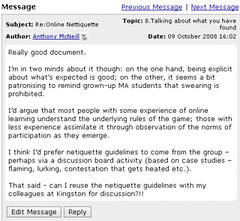
Literacy event 4: discussion board post

I guess this belongs to the domain of university (school for grown-ups)? It's a discussion board post to a thread on online netiquette so I guess the literacy practice is responding to a tutor's question.

discussion board post

Part of me is revelling in the new-found ability to articulate my own opinions (I'm usually using boards as a moderator/facilitator where I have much less freedom to have my say).

However, I can't be too confrontational and I don't want to give offence to the course team. So, even though I criticise the netiquette document, the criticism in enclosed in a 'praise burger' (i.e. two complimentary slices of soft bun-like praise). I'm trying to look at the issue from a couple of angles and understand why the guidelines are included. I close the post with an attempt at humour - cued by manic use of exclamation marks - to defuse any possible offence and to present myself as an approachable team player.

The persona I might be trying to construct in this - but perhaps more so in other posts - is a kind of guy you can knock ideas back and forward with. I'm not suggesting that I'm not like that in 'real life'; simply that in the context of a course where we don't know one another, it's important to present oneself as open to new ideas and respectful of others' opinions.

Literacy event 3: SNS wall post

Elgg (open source SNS) wall-to-wall exchange with a work colleague. The domain is work but the informality in the exchange and its subject matter relate to the home domain. The literacy practice is asking for recommendations.

SNS wall literacy practice

It's the early days of the Elgg installation so we're posting things as part of the process of getting to know how it works. The colleague whose wall I'm posting to is not a friend although we get on well and share similar interests. He's a good guy to talk to about techie things and is generous in his advice. There's none of the banter that's found in the txt message though because I don't know him so well and there's less shared history and discovered commonality.

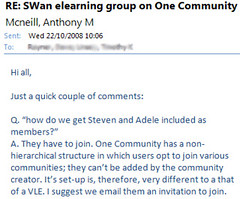
Literacy event 2: a work email

This is a work-related email to two colleagues, one of whom is my line manager). The literacy practice is answering a question/solving a problem.

I'd say we've a more formal working relationship - formal in an HE, not a armed forces way - and the email is in response to an earlier email articulating some problems with our Elgg (an open source SNS) installation.

work email literacy practice

Sections of the earlier email are quoted and answers fairly brief. Key issues are explained and a way forward outlined. There's no conversational joking - it's all to-the-point, professional stuff.

I tend to use email in lieu of a phone call, especially when:
  • multiple recipients are involved
  • I want to leave an audit trail ("at today's meeting we agreed to ...")
  • I'm pressed for time and want to avoid the small talk that a phone call entails ("Hi X, how are things etc., etc. ... the reason I'm calling is ...")
Is another reason I use email a lot to do with the culture of the workplace where email is the default medium, even replacing face-to-face conversations with colleagues who are only a few doors down the corridor?

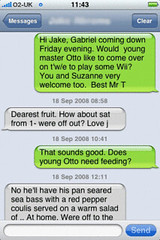
Literacy event 1: a txt exchange

Right, let's have a go at looking at my own literacy events.

Here's a short exchange of txt messages between a myself and a friend. We're a similar age, work in the same place and have sons the same age. The messages are about arranging for the boys to get together. The literacy practice then is 'agreeing a date/making an apointment. The domain is home, not work.

txtchat1a

I have a particular style with this friend: lots of in-joke references to our middle-class lifestyles and privileged children, 'pet' names only used in emails and txts ('Mr T')' some camping it up ('dearest fruit'). Banter (mock offensiveness) is a key aprt of how we communicate textually (less so in spoken English). It's not a style I replicate with other friends - it's part of a particular dynamic between us. I think this shared style evolved over time and involved initiation and uptake. A style got developed and stuck.

My literacy practices

My literacy practices these days are predominantly technology-mediated.

Typically, in a day, I:

  • txt/send SMS messages
  • email
  • post to blog
  • post to discussion boards (my own KU courses as well as external ones I'm a student on)
  • post to walls, comments boxes etc on One Community (our Elgg installation)

Because these literacy practices are technology-mediated and asynchronous, I'm engaging in them at various times and places: home and office, working hours and early mornings or evenings.

It's difficult, given the informality of my working environment and good relationships with colleagues, to differentiate home literacy practices and work-related literacy practices. The domains may be different but I'm not sure the literacy practices are massively different.

I'm with Barton on the porous nature of domains:

The practices leak from one domain to the other and there is much overlap.
(Barton 1994: 40)


References

Barton, D. (1994) Literacy: An Introduction to the Ecology of Written Language. Oxford: Blackwell.