Showing posts with label Twitter. Show all posts

Wednesday, 5 May 2010

Embedding tweets in a web page

Here’s a tool that enables you to embed tweets into a website or blog post:


This is what is looks like:

Finding Creative Commons Images on Flickr http://screenr.com/XnWless than a minute ago via Screenr

Friday, 23 April 2010

It woz social media wot won it?

I've no idea what the impact of social media will be to the outcome of the general election (6 May 2010). However, it's played a big role in making it one of the more enjoyable elections I can remember.


Traditional broadcast media have played some role in the higher levels of entertainment on offer and the US-style televised debates stand out here. However, it's on Twitter, Facebook and various ad-busting-style blogs and sites where the real fun's to be had.


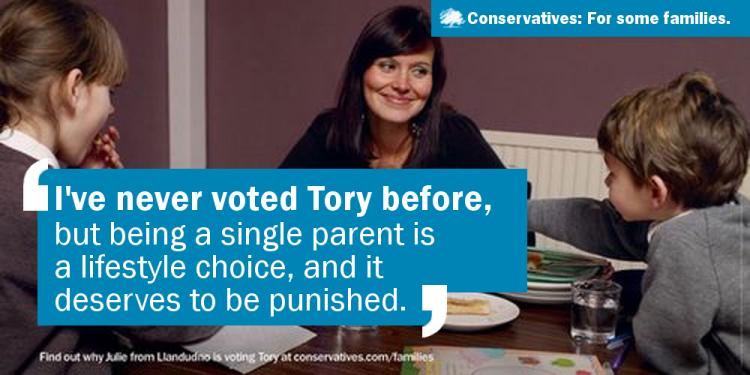
What are the high points for me so far? Well, it's got to be the Tories' inept poster campaign (hey, thanks Michael Ashcroft) and the extraordinary speed, creativity and wit of the DIY digital image manipulators who've responded to it. Is England, in fact, a nation of PhotoShopkeepers?

So, in response to the cheesy and heavily airbrushed poster boy image of Cameron, we have the Mydavidcameron web site and dozens of user-generated spoofs. Flickr has a fair few images of more old-skool spray-can tactics (see Fuck off back to Eton) which also raise a smile. Cameron as posh, Toryboy (see the Common People spoof) is a common trope.

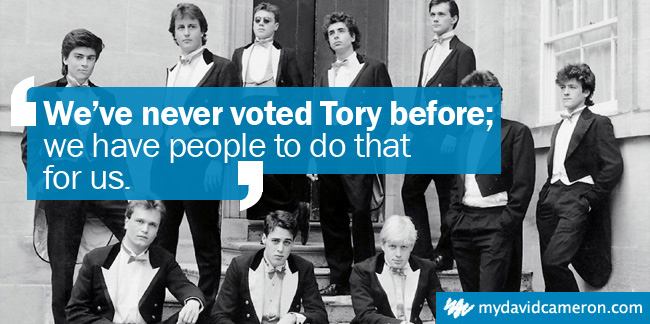
Every slogan - e.g. 'I've never voted Conservative before but ...' - becomes the set up for hundreds of gags like those found on the I've never voted Tory blog. It's a big, distributed parlour game with thousands joining in the fun.


There's a delightful escalation of the conflict going on: the more the Tories attempt to make their posters unspoofable, the more desirable a target they become to the "big society" (lol!) of DIY satirists (see Internet spoofs unspoofable Conservative poster). And the more the spoofs take off on Twitter and in the blogosphere, the more likely the phenomenon is to be reported in mainstream broadcast media. Yesterday, both Channel 4 news and The Guardian, for example, covered the reaction on Twitter - thousands of tweets using the #nickcleggsfault hashtag - to attacks against Clegg by the Murdoch press.


What's going on is really interesting; it feels like political satire is no longer the preserve of a few - the writers of Have I got news for you, Private Eye, In the Loop etc. - but the many. Is the best political satire now digital, distributed and user-generated? And will it make a difference?

Monday, 11 January 2010

Twitter for reflective activities

Twitter presentation for the University of Staffordshire online Twitter workshop:

Tuesday, 30 June 2009

Twitter and May '68

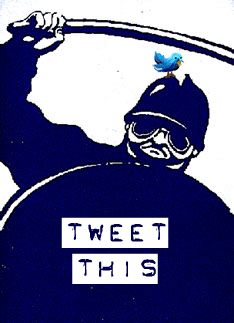
Not really sure why - possibly hot weather making me a bit lethargic and unfocussed - but I've started to mess around with some old May '68 posters.

tweet this

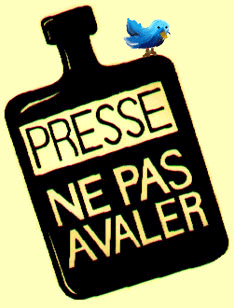
I guess I'm remixing them for a digital era of cameraphones, Flips and social media. Iran and Twitter is still in the news (just) but I guess I'm still thinking about the G20 demonstrations in London. The violence of the policing was remarkable as was the initial mainstream media reporting that uncritically adopted the line fed them by the Metropolitan Police.


twitterpress

It took media outlets like The Guardian who picked up on user-generated content - especially the assault on Ian Tomlinson - to call into question official accounts.

Wednesday, 24 June 2009

The revolution will be twitterized (and forgotten)

This is the headline of an opinion piece in today's Le Monde by Corine Lesnes (La révolution sera twitterisée... et oubliée). It's more of a (sceptical) introduction to a technology that's making the headlines all over the world but which has so far had little impact in France. Not sure why - I've always seen the French as early adopters of this sort of thing (think Minitel in the 1980s).

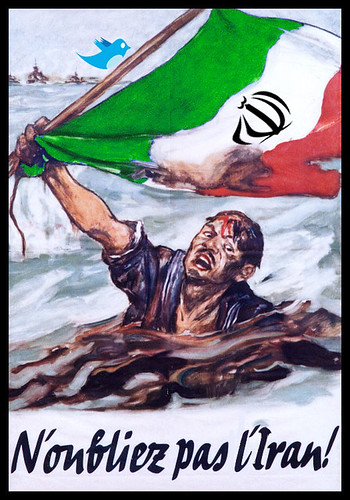
Don't forget Iran!

Here's a variant (in English) from over a week ago (The Revolution Will Be Twittered)

Anyway, the reworking of Gil Scott-Heron's 'The Revolution will not be televised' ("... the Revolution, brother, will be live") raises an interesting question about the role of a new technology in representing political action and social change.

There are a couple of ways to write about Twitter and the Iranian crisis of legitimacy: 1) a study of the use of Iranian twitterers and, 2) western media reaction to the use of this emerging technology.

BTW, Gil Scott-Heron should really have copyrighted the title 'The Revolution will not be (add technology)ized'.

Friday, 1 May 2009

Skinheads, fashion, gay men, Twitter and reappropration

Just got up and haven't had a cup of tea yet. I'm getting my excuses in early about the confused nature of today's post.

One of the tweeps I'm following looks to be doing some interesting research on skinhead subculture. It made me think back to my teen years (late 70s/early 80s - 2nd generation skinheads) and my fear of them back then. Also of Shane Meadows' This is England (what a great film!) and its take on skinhead subculture (one DM in a benign w/c subculture into black music; another DM in belligerent far right politics).

It also got me thinking about a scene in a Jake Arnott novel (was it The Long Firm?) where a first generation skinhead character, who's just got out of prison after a long sentence, thinks another skinhead on the tube is trying to pick a fight with him. It turns out to be a gay skin checking him out and after a different kind of physical interaction.

The problem for our ex-con is that the signs of male 'hardness' (Levis, Ben Sherman shirts, DMs, bomber jacket etc.) have been reappropriated by another subculture. Signs and symbols are in perpetual motion and 10-15 years behind bars have left Arnott's old skinhead unable to read their meanings with any degree of accuracy.

Anyway, this long digression to say I think that's sort of what happens with technology. A technology like Twitter, first envisaged as a notification service ("What are you doing?"), a lightweight Facebook status update-type tool (thoough with all the clutter removed, gets reappropriated, reinterpreted, remade in diverse ways by different groups: for marketing, broadcasting, professional development, learning, constructing new discursive spaces etc..

That's all for now ... enjoy Prince Buster:


Wednesday, 29 April 2009

Are "dinner tweets" really trivial?

Are 'dinner tweets' - you know those tweets describing what the twitterer is about to tuck into (e.g. "I'm preparing pan-fried seabass on a coulis of ...") - really as trivial as Twitter's detractors claim?


I'm tempted to argue that they play a part in the 'taste performances' (Liu 2008) that are integral to most social networking sites. It's one of the ways I project or perform my identity online.


By describing to followers what I'm preparing and/or eating I'm also performing a particular identity. For example, if I tweet that I'm cooking a dish with locally-sourced ingredients that keeps the food miles down, I'm projecting an identity that's discerning and environmentally aware; if, on the other hand, I tell you I'm serving up a dessert of frozen Creme Eggs, the identity I'm performing is offbeat and fun-loving.

Far from being part of the anti-Twitter camp's imagined stream of trivia, the 'dinner tweet' is, in fact, an integral part of the repetoire through which twitterers perform the 'ongoing narrative of the self' (Merchant 2006: 238).

So, next time someone moans about 'twitterhea' and the banality of the 'dinner tweet', tell them it's all about identity performance and refer them to Pierre Bourdieu and Anthony Giddens.


References

Liu, H. (2008). Social Network Profiles as Taste Performances. Journal of Computer-Mediated Communication, 13(1): 252-275.
Retrieved April 29, from http://jcmc.indiana.edu/vol13/issue1/liu.html

Merchant, G. (2006). Identity, Social Networks and Online Communication. E-Learning, 3(2): 235-244

Tuesday, 28 April 2009

Twitter profile field as minimal - but laminated - identity performance

Here are some example bios:
  • e-learning, read/write web, participation, user-centred, activism, agency, democracy, curry, beer, cycling, cricket, football, indie music, indie film

  • lecturer, researcher, poet, new-ish father

  • Researcher (e-Learning, m-Learning and technology enhanced learning), vather, techgeek and i am a mac-user ;-)

  • Library geek, datamonger and allotmenteer

  • librarian, mom, social media, information literacy, punk rock, 60s reggae, edupunk, educational technology, author, subcultures, chronic overtweeter

  • Librarian and repository manager for a X university by day; blogger, video maker, writer, gamer. Lord of all weasels, llamas and gooses by night

  • Community building and general change management for online distance learning. Running. Cider. Electric bicycles.

  • Learning Technologist wondering why the one line bio is 160 characters??

  • Married with 2 boys who have now flown the nest. Work in education, teach ICT and love gadgets

  • dad, senior learning technologist at University of X, educational technology consultant, moodle guru and uncompromising bike commuter
What identities are performed here? Professional certainly (learning technologist, librarian, teach IT). Personal too - as mothers or fathers (mom, dad, newish father). As fans (indie music, indei film). As politically committed to particular causes (democracy, user-centred activism). Affiliated to a a myriad causes, interests, affinity spaces ...

More to follow.

Sunday, 26 April 2009

Twitter, the backchannel and 'laminated discursive spaces'

Initial random thoughts on a Sunday morning (woken by children and unable to get back to sleep) on Twitter, the backchannel and 'laminated discursive spaces'.

What do I mean by 'laminated discursive spaces'? Um ... I don't stop being a father, husband, francophile, daydreaming timewaster, rebellious teenager (in his mid-40s!) etc. just because I enter a lecture theatre. Although a singular aspect - or one layer of a laminated identity - may be more in play in one particular context (e.g. my academic identity when I'm at a conference) , other identities may also enter the foreground too. So, there's always some element of identity lamination on our social interactions and I think the Twitter backchannel exemplifies this really well.

Here's a great quote from an article I've been reading:
Because social practice is dialogic, heterogeneous and distributed in functional systems, activity should be understood as laminated or layered in Goffman’s sense, and, following Goodwin and Duranti, as mutable, dynamic frames that are relatively foregrounded or relatively backgrounded. Thus, there are no spaces where the social histories of people, practices, artifacts, and institutions disappear, no pure monologic activity systems, no places where identities can be figured simply in terms offered by a dominant institution’s map (where a person is just an engineer, just a student, just a teacher). Lamination is not simply a notion of the multiple identities of the person, but also applies to mediational means, with heterogeneous histories embedded as affordances in the words, texts, tools, and institutions that mediate activity.
Prior, P. (2003). 'Are communities of practice really an alternative to discourse communities?'
Paper presented at the 2003 American Association of Applied Linguistics (AAAL) Conference
Accessed from: https://netfiles.uiuc.edu/pprior/Prior/PriorAAAL03.pdf

I think the Twitter-enabled conference backchannel is an example of a 'laminated discursive space' . What I've observed in the #pelc09, #shock09 and #beyond09Twitter backchannels are different socioliterate practices - some academic, others less so - woven into a stream of hashtag-specific conference tweets:

  • posting links
  • brief summaries
  • expression of appreciation/thanks to individual presenters/conference organisers
  • side conversations between participants (remote and proximate)
  • banter (participants also have a shared social history of nights out, common interests and projects, past conferences, shared contacts)
  • bitching ("salespitch suckfest" was one comment on an Apple presentation deemed too corporate)
  • sharing of other resources (mainly photos and URLs)
  • requests for information or attempts to collaborate (e.g. on a set of Delicious bookmarks)

Thursday, 23 April 2009

Twitter workshop ideas

These are my rough notes from Matt Lingard's workshop

Section 1: face the front bit with Matt talking


Starts with personal use of Twitter for professional purposes. Also brings in a few strong quotes about the importance of Twitter culturally and economically.
Those who criticise use of Twitter at work haven't seen the tectonic plates moving. Social networks such as these are the way businesses will be run in the future.
Victor Keegan Technology Guardian
http://www.guardian.co.uk/technology/2009/jan/29/twitter

Twitter practicalities
  • create an account

  • you'll need a username - this can be anything you like but you should also add your own details as this will help people follow you.

  • The home page - this displays the tweets of those that you are following. The core of Twitter is to follow people.
Matt has a really good PowerPoint that makes a distinction between the Home and Profile pages.

Matt showed a video (Martin Weller: Twitter Love Song) that explained what it was and how it might be used.

Types of tweet:
  • @ replies

  • direct messages

  • retweets

Other Twitter stuff

  • embedding links

  • uploading photos

  • hashtags

  • Twitter searches

Next bit is the hands-on.

Section 2: hands on session

Matt gave a useful handout.


Matt got us to write on a postit our usernames then put then up on a PowerPoint slide. We were then asked to follow fellow participants and interact via tweets.
  • uploading pictures (Mobypicture)
  • adding feeds (Twitterfeed)
  • hashtags
  • Twitter searches

Presentation available online at: http://www.slideshare.net/madrattling

Wednesday, 8 April 2009

Twitter and passing notes in class

One of the things I noticed at the Shock of the Old 2009 conference ('official' and 'unofficial' hashtags) was the largish number of participants sending tweets during presentations. The "backchannel" has found, or so it seems, a new technology.

Idea for paper: More than just passing notes in class?: tweets as new literacy practice. (my online survey)

My initial suspicion was that sending tweets 'remediates' the analogue textual practice of passing notes in class. However, I think there's more to it than that.

My hunch is that it's being used as a space to quibble, query and demur, to have off-stage dialogues with like-minded colleagues or contacts either present in the lecture theatre or elsewhere. So Twitter is a another means, potentially, of breaking the broadcast/monologic format of the conference paper and providing additional opportunities for comment and dialogue.

I think it's also - and some of the comments on the LDHEN JISC mailing list almost confirm this hunch - a space for the performance of identities at odds with those expected of colleages at a conference (e.g. for flippant, dismissive or bitchy commentaries that can't easily be made public via a comment or question to the speaker).

I’m coming from a position that views literacy practices as complex social acts that can be inclusive or exclusive. Web 2.0 doesn’t automatically = inclusive/democratic.

On the one hand I can see how the use of Twitter exemplifies one form of ‘networked participatory culture’ (Jenkins) by enabling new forms of conversation; on the other hand I can see how the technology provides a platform for opportunistic gossiping which can shut out other participants (e.g. those who are not Twitter users).