Wednesday, 18 March 2009

Physical and virtual space

... we need to treat Internet media as continuous with and embedded in other social spaces (Miller & Slater 2000: 5).
The idea of space having been fractured refers to the emergence of cyberspace as a distinctively new space that co-exists with physical space. Cyberspace has not displaced physical space, of course, and will not displace it. Nor, however, can physical space dismiss cyberspace. For the majority of young people in so-called developed countries who are now in adolescence, cyberspace has been integral to their experience of 'spatiality' since their early years. […] Co-existence is the destiny of these two spaces (Lankshear and Knobel 2006 :31-2).

References

Lankshear, C. and Knobel, M. (2006). New Literacies: Everyday Practices and Classroom Learning. Maidenhead: Open University Press

Miller, D. & Slater, D. (2000). The Internet: An Ethnographic Approach. Oxford: Berg.

New Literacy Studies, New London Group, New Literacies


  • New Literacy Studies: coming out of work by Gee and Street and Heath and Barton and Hamilton that specifically looked at literacy as a social practice. focusing on domains of practice.

  • the 'new literacies': comes more from the work of Lankshear and Knobel, identifying ways in which literacy is now something very different when considered in relation to the new communicative landscape. This 'new literacies' draws on theory from new literacy studies, but also draws on theory from other sources, particularly the 'New London Group' (Kress, Cope and Kalantzis and others) that looked at ways of understand meaning making in relation to Design and multimodality.

That dana boyd quote on 'glocalization'

The digital era has allowed us to cross space and time, engage with people in a far-off time zone as though they were just next door, do business with people around the world, and develop information systems that potentially network us all closer and closer every day. Yet, people don't live in a global world - they are more concerned with the cultures in which they participate. (boyd: 2006)


Reference


boyd, d. (2006). 'G/localization: When Global Information and Local Interaction Collide.' O'Reilly Emerging Technology Conference, San Diego, CA. March 6.

My definition: RSS feeds

RSS stands for Really Simple Syndication.

The basic principle is that if a user decides that a web site such as the BBC News web site or a blog, has regularly updated content worth following, they can ‘subscribe’ to it. This involves finding the RSS feed (a kind of web address) for that site usually represented by an orange icon.

The users then copies the feed into something called an RSS reader (aka RSS aggregator) which displays the titles of new articles or posts as well, generally, as the first few lines. The user can then skim read the list that it produces. Clicking on any item in the list will take them to the full article. RSS readers include Google Reader but I like personal start pages like iGoogle, Netvibes and Pageflakes which also include this functionality.

Here's another great YouTube video definition:


For mash get Smash

There's an advert I loved as a kid (now, of course, on YouTube, that repository of collective cultural memory).

The ad was for a powdered mash potato mix (mmmm ... yummy) and featured robots from outer space laughing at simple earthlings making do with peeling and cooking actual potatoes.


It's how I think my own (digi)kids will react when I show them my old LPs (maybe even books?).

Gee on essayist literacy

A further significant aspect of essayist prose style is the fictionalization of both the audience and the author. The 'reader' of an essayist text is not an ordinary human being but an idealization, a rational mind formed by the rational body of knowledge of which the essay is a part. By the same token the author is a fiction, since the process of writing and editing essayist texts leads to an effacement of individual and idiosyncratic identity. (Gee 1990: 60-61)

References

Gee, J. Social Linguistics and Literacies: Ideology in Discourses (2nd edition)

Barthes: landscape in a bean

Ok, I'm going to use my blog in a really 'bad' way to post quotations and definitions I use/need a lot.

Here's the first:

There are said to be certain Buddhists whose ascetic practices enable them to see a whole landscape in a bean. (Barthes 1974: p.3)


References

Barthes, R. (1974) S/Z. New York: Hill and Wang.

Monday, 9 March 2009

Rough notes on the mobile internet

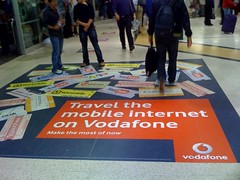
One of the developments we've been looking at a lot recently is the growth of the 'mobile internet/mobile web'.

As an enthusiastic iPhone user I want to attribute this growth to Apple but suspect it's mainly:

  • mobile phone operators offering reasonably-priced (?) flat rate deals with unlimited internet access;

  • said mobile phone operators advertising the benefits of being able to access favourite sites ;
Mobile
  • the proliferation of handsets and mobile browsers that give users access to a web that looks recognisably web-like (and not a horribly adulterated version). I think the iPhone set a standard that others still have to beat - there's no 'iPhone 'killer' yet although Samsung and LG are gaining ground - unlike Nokia and Blackberry.
iPhone fanclub (Surbiton branch)

Related to this I guess is the growth of the 'mobile app'. Here Apple's influence is again dominant with Microsoft and Nokia opening their own applications store. The apps I use on my iPhone for Facebook and Google are great - I wish we had something like it for our VLE.

Facebook on iPhone

Wednesday, 25 February 2009

Technology scare stories

I'm posting belatedly on this non-story only as a convenient space to dump some links.

This article is a cool look at the data and links to some of the more lurid headlines of the tabloids:

Facebook 'cancer risk' http://www.nhs.uk/news/2009/02February/Pages/Facebookhealthstudy.aspx

Tuesday, 20 January 2009

Here's a quote I like on the 'digital native' question

Talking about youth as digital natives implies that there is a world which these young people all share and a body of knowledge they have all mastered, rather than seeing the online world as unfamiliar and uncertain for all of us.
Henry Jenkins
http://www.henryjenkins.org/2007/12/reconsidering_digital_immigran.html